


Your move
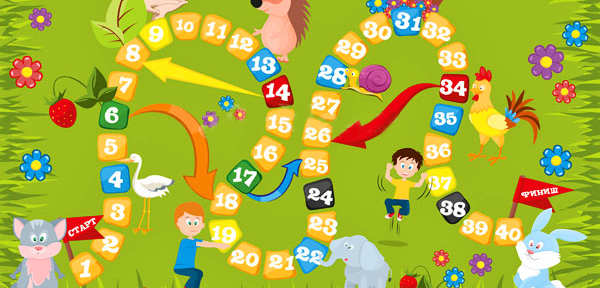
The use of game-based learning in foreign language teaching, including Russian as a foreign language (RFL), has attracted considerable attention recently. Games in RFL lessons are one of the more “fashionable” educational trends. In addition, new technologies that incorporate game elements are also generating considerable interest among teachers, partly because their potential remains underexplored.
One of the simplest and most practical ways to use games in RFL lessons is for teachers to create roll-and-move board games with a playing board and game pieces. They can be used in small groups or during one-to-one lessons, provided that the teacher takes part in the game.
You may have noticed that many textbooks include roll-and-move games for revising previously covered material, for example, after every five lessons, or for an overall review at the end of the book. One such example can be found in the A1-level textbook “Точка.ру”.
However, teachers do not have to rely on textbook materials when creating games for revision. Anyone can create a roll-and-move game in Microsoft Word or even “draw” one by hand and make copies for students to use in class.
Here are some answers to questions that beginner teachers may have about using these games in the classroom.
Question 1. Why is revision through roll-and-move games effective?
These games give students an opportunity to revise material they have already studied in a relaxed setting while using spontaneous spoken Russian:
1. if the game element is used appropriately and at the right point in the lesson;
2. if the teacher incorporates interesting visual materials, such as pictures and illustrations, into the roll-and-move games;
3. if the teacher can create tasks that combine humour with educational value;
4. if the game is methodologically well designed.
Moreover, games also help activate memory because they tend to increase students’ motivation.
Question 2. What does a roll-and-move game look like?
Remember the roll-and-move games we played as children, such as the popular game based on Agniya Barto’s poems, “С утра до вечера”. Naturally, there are many modern games for Russian speakers based on the same principle. A roll-and-move game for use in our lessons can look much the same. Its design will depend on the teacher’s imagination, methodological skills, knowledge of the students and ability to work with images and so on.
Another good example of a roll-and-move game for Russian speakers, with elements of country studies, is “Путешествие по России”.
Question 3. What should you pay attention to when creating roll-and-move games?
It is very important to use only material that students have already covered and to make sure that it is appropriate for their level. It is also worth including a variety of activities related to grammar, communicative situations and vocabulary. The teacher should also remember that the game needs to be interesting and engaging for the students, so humour can be a useful part of its design.
As strange as it may sound, the game itself should contain a genuine element of play. This can be achieved in a number of ways:
• interesting tasks: asking students to suggest synonyms and antonyms, explain words, act out words or sentences using facial expressions and gestures, find a mistake in a sentence, role-play a short communicative situation, or come up with a response to a specific question related to that situation. It is better when tasks are connected in some way with the student’s personal experience, without excessive intrusion on the part of the teacher, of course, as this provides additional motivation;
• elements of “excitement” in the game: it is not always particularly engaging to have students simply move around the board by rolling a die. It is better to include situations where players can move forwards or backwards, jump to another level, follow different routes depending on how successfully they complete tasks, and encounter both easier and more difficult challenges and so on.
Question 4. When can roll-and-move games be used?
As we have already mentioned, the main purpose of using roll-and-move games is to revise material that students have already studied. It is therefore best to use them after students have completed several lessons in a textbook, covered particular lexical and grammatical topics, or worked through specific communicative situations and so on. At the same time, these games can also be useful for assessing students’ level, especially when there are many students. A similar game can be offered instead of a traditional test, while the teacher monitors how each mini-group progresses through the game, noting the students’ mistakes and difficulties. Another effective use is to revise previously covered material after a long break, such as the holidays or vacations. In this case, the lesson can begin with a game.
Roll-and-move games can also be used during lessons held for special occasions, particularly New Year’s lessons. They can help activate New Year-related vocabulary and communicative situations while also providing entertainment. Such games can include New Year-themed forfeits and scenarios, of which there are now many available online. Roll-and-move games can also be “linked” to particular lexical and communicative topics, such as “Travel”, “Family” or “City”.
Question 5. Can roll-and-move games be used in one-to-one and online lessons?
Yes, they can. At the same time, the teacher must take part in the game with the student, answer the same questions, and monitor their own vocabulary, knowledge of grammar and command of communicative situations. The student will undoubtedly appreciate the teacher’s participation. Among other benefits, playing together can help overcome the psychological barrier that often exists between a student and teacher, especially during the first few lessons.
These games can also be used online. There are two options:
• the student can print out the game, roll the die and move around the board in front of the camera, just as the teacher does;
• the teacher can send the student the game in electronic form and use a virtual die during the game.
Regular use of roll-and-move games in lessons can significantly increase students’ motivation, strengthen relationships within the group and build students’ trust in the teacher. All of this contributes to a more effective learning process.
Author: Yulia Amlinskaya, head of the international online school of RFL “Russificate” and the international online school for bilingual children “Russificate Kids”, teacher of Russian as a foreign language, administrator of the community “Teachers of RFL”.