Сервисы
Поиск

Международный информационно-просветительский проект

русский язык
для всех и каждого
как иностранный
  • Публикации
  • Новости
  • Лингвистическая помощь
  • Видео
  • Онлайн-тесты
  • Филологические порталы
  • Как готовиться?
  • Как писать сочинения?
  • Что почитать?
  • Как анализировать текст?
  • Коротко и ясно
    • Говорим правильно
    • Пишем правильно
    • Выбираем форму слова
    • Расставляем знаки препинания правильно
    • Спрягаем глаголы правильно
  • Учись весело
    • Скороговорки
    • Весёлая акцентология
    • Пословицы и поговорки
    • Занимательная этимология
    • Нескучный русский
  • Словари
    • Школьные словари
    • Фундаментальные словари
    • Словари для интеллектуальных гурманов
    • Базовые настольные словари
    • Малые настольные словари
    • За словом в карман
  • О проекте
  • Публикации
  • Новости
  • Лингвистическая помощь
  • Видео
  • Тестирование по РКИ
  • Начинающим преподавателям
  • Russian lessons with Tanya Semke
  • Хочу преподавать РКИ
  • Полезные сайты и порталы
    • Для преподавателей РКИ
    • Для изучающих РКИ
  • Хочу учиться
    • Курсы РКИ
    • Подготовительное отделение для иностранных граждан, планирующих поступать в российские вузы
  • Методическая копилка
    • Литература по РКИ
    • Статьи, учебники по РКИ
  • Образы русского слова
  • Стихи и песни на русском языке
  • Ближе к России. Омск
  • О проекте
  • Russian lessons with Tanya Semke
  • Образы русского слова
  • Хочу учиться
    • Курсы РКИ
    • Подготовительное отделение для иностранных граждан, планирующих поступать в российские вузы
  • Начинающим преподавателям
  • Полезные сайты и порталы
    • Для преподавателей РКИ
    • Для изучающих РКИ
  • Хочу преподавать РКИ
  • Методическая копилка
    • Литература по РКИ
    • Статьи, учебники по РКИ
  • Тестирование по РКИ
  • Как готовиться?
    • Как готовиться к экзаменам?
    • Как готовиться к олимпиадам?
    • Учебники и справочники по русскому языку и литературе
    • Высказывания о русском языке
  • Как писать сочинения?
    • Как писать сочинение-рассуждение?
    • Как писать сочинение-описание?
    • Как писать сочинение-повествование?
    • Как писать итоговое сочинение?
    • Как писать изложение?
  • Что почитать?
    • Книги в дорогу
    • Что почитать в самолёте?
    • Веселые книги
    • Cписок литературы на лето для учеников 2-11 классов
  • Учись весело
    • Скороговорки для улучшения артикуляции
    • Весёлая акцентология
    • Пословицы и поговорки о языке и речи
    • Занимательная этимология
  • Склонение фамилий

учредитель проекта


Международный информационно-просветительский проект

  • Русский Язык
    для всех и каждого
    Публикации Новости Лингвистическая помощь Видео О проекте
    • Онлайн-тесты
      Проверьте и актуализируйте свои знания в области русского языка и литературы
    • Филологические порталы
      Подборка сайтов, призванных оказывать филологическую помощь
    • Как готовиться?
    • Как писать сочинения?
    • Что почитать?
    • Как анализировать текст?
    • Коротко и ясно
      • Говорим правильно
      • Пишем правильно
      • Выбираем форму слова
      • Расставляем знаки препинания правильно
      • Спрягаем глаголы правильно
    • Учись весело
      • Скороговорки
      • Весёлая акцентология
      • Пословицы и поговорки
      • Занимательная этимология
      • Нескучный русский
    • Словари
      • Школьные словари
      • Фундаментальные словари
      • Словари для интеллектуальных гурманов
      • Базовые настольные словари
      • Малые настольные словари
      • За словом в карман
    Интересное
    публикации
    Шашлык на у́глях или на угля́х?
    30.04.2026
    269
    публикации
    «Судя по…» -  где ставить запятые?
    29.04.2026
    268
    публикации
    Утерянный и потерянный: в чём разница?
    22.04.2026
    285
    публикации
    Не все слоны слоняются
    03.04.2026
    124
  • Русский Язык
    как иностранный
    Публикации Новости Лингвистическая помощь Видео О проекте
    • Тестирование по РКИ
      Ориентированное на изучение русского языка иностранцами
    • Начинающим преподавателям
      Советы эксперта
    • Russian lessons with Tanya Semke
    • Хочу преподавать РКИ
    • Полезные сайты и порталы
      • Для преподавателей РКИ
      • Для изучающих РКИ
    • Хочу учиться
      • Курсы РКИ
      • Подготовительное отделение для иностранных граждан, планирующих поступать в российские вузы
    • Методическая копилка
      • Литература по РКИ
      • Статьи, учебники по РКИ
    • Образы русского слова
      Пословицы, поговорки, крылатые выражения о языке и речи
    • Стихи и песни на русском языке
    • Ближе к России. Омск
    Интересное
    публикации
    Шашлык на у́глях или на угля́х?
    30.04.2026
    269
    публикации
    «Судя по…» -  где ставить запятые?
    29.04.2026
    268
    публикации
    Утерянный и потерянный: в чём разница?
    22.04.2026
    285
    публикации
    Не все слоны слоняются
    03.04.2026
    124
Сервисы
  • Склонение фамилий

Учредитель проекта

Проверить слово
Склонение числительных
Словарь синонимов
Словарь антонимов
Словарь паронимов
Строчная-прописная
Ваш вопрос
Проверить слово
  • Главная
  • Русский язык как иностранный
  • Russian lessons (video)

Russian lessons (video)

  • Lesson 69. More must-know action words
    Lesson 69. More must-know action words
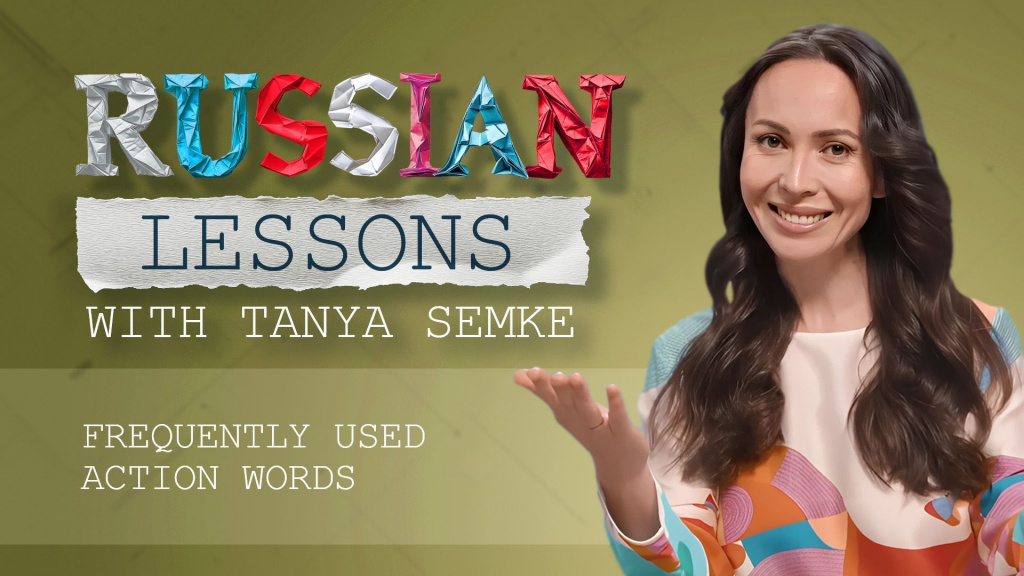
    In addition to practical skiing advice from Tanya Semke, this lesson expands your vocabulary with useful action words like “smile”, “laugh”, “hope”, “do your best”, “get ready”, “get dressed”, and “fear”. You’ll also learn how to discuss activities such as riding a horse, biking, scootering, skiing, and ice skating.
  • Lesson 68. Showing off your skills
    Lesson 68. Showing off your skills
    In this lesson, you’ll learn how to confidently show off your skills when introducing yourself in Russian. You’ll be able to say “I can,” “I know how to,” and “I’m good at” while talking about sports, musical instruments, singing, dancing, and painting.
  • Lesson 67. Discussing future plans
    Lesson 67. Discussing future plans
    In this lesson, you will learn how to ask and answer different questions about near-future plans – like “What are you doing tonight?” or “What are your plans for tomorrow?”
  • Lesson 66. How to talk about future?
    Lesson 66. How to talk about future?
    You already know how to talk about actions in the present – so now it is time you learned how to describe the future and give promises!
  • Lesson 65. "Well-better", "bad-worse", and more comparatives
    Lesson 65. "Well-better", "bad-worse", and more comparatives
    Today, you will join Tanya and her husband on a restaurant date to pick up some hugely useful words like "well", "badly", and "often" plus their comparative forms "better", "worse", "more often", and others. You will also get the hang of how to give advice in Russian. All you need to compare, comment and counsel is in this lesson!
  • Lesson 64. Discussing social stereotypes
    Lesson 64. Discussing social stereotypes
    In this lesson, you will learn how to express generalisations in Russian – like saying “All women do …” You will also pick up handy phrases to agree or disagree in conversations.
  • Lesson 63. One form for Present Simple and Present Continuous in Russian
    Lesson 63. One form for Present Simple and Present Continuous in Russian
    Time for a key grammatical insight – and a pleasant one! In Russian, there is no distinction between Present Simple and Present Continuous forms. So whether you want to say “They work” or “They are working”, you simply use the same form: “Они работают”. Relax and enjoy this bit of grammatical good luck!
  • Lesson 62. Tanya’s having shower or Present tense
    Lesson 62. Tanya’s having shower or Present tense
    This lesson focuses on ongoing actions – you will learn how to say what you are doing at the moment and how to ask others: “What are you doing now?” Do not miss this one as you will gain some essential Russian grammar.
  • Lesson 61. Talking about obligations in Russian
    Lesson 61. Talking about obligations in Russian
    You will learn to talk about obligations using the key Russian word for "must". We will cover its four different forms so you can say what you – or others – have to do.
  • Lesson 60. Sports games in Russian
    Lesson 60. Sports games in Russian

    This lesson is almost hijacked – yet again – by Tanya Semke's little son, who is always willing to play. Still, she powers through to teach you how to suggest an activity and agree to a proposal using just one word. You will also pick up several names of sports and games from this lesson.

  • Lesson 59. Describing origin of things
    Lesson 59. Describing origin of things

    When communicating across cultures, it is often important to talk about where things come from. In this lesson, you will learn words like "Russian", "African", "Indian", "Chinese", "Arabic", "Argentinian" along with many others. You will also discover how to use them in popular collocations such as "Chinese tea" and "Brazilian football".

  • Lesson 58. Seasonal activities
    Lesson 58. Seasonal activities

    You will get to know the names of the four seasons and see what each one looks like in Russia – you might be surprised by how different the climate can be! Along the way, you will pick up some handy phrases for activities you might enjoy, like "go for a walk" and "listen to music", "swim" and "sunbathe", "study languages" and "take photos".

  • Lesson 57. Sleepy Tanya or Daily routine
    Lesson 57. Sleepy Tanya or Daily routine

    It's time for you to learn how to describe your day in Russian with 11 essential action words. You'll master words for daily actions like "to sleep", "to read books", "to lie in the bed", "to write emails", as well as phrases for meals and different times of the day.

  • Lesson 56. Asking "what for…?" and saying "to…”
    Lesson 56. Asking "what for…?" and saying "to…”

    This lesson is a proper milestone in your Russian language journey with Tanya Semke, as it introduces you to action words, or as linguists call them "verbs"! From now on, you will keep building up your vocabulary with more and more words for different actions. In this session, you will learn essential ones like "to help", "to work", "to earn", "to rest", "to travel", and "to buy". There is even a philosophical twist – Tanya has to tackle a tricky question from her child “Why work?” – which is not the easiest one to answer.

  • Lesson 55. "Glad", "Excited", "Happy", "Ready", and "Married" in Russian
    Lesson 55. "Glad", "Excited", "Happy", "Ready", and "Married" in Russian

    Family values are deeply important in Russian culture, which makes learning to talk about them absolutely essential. In this lesson, we will cover some key words like "wedding", "husband and wife", "married", and "happy" as well as how to say someone is married – which in Russian tells you more than just a status.

  • Lesson 54. Clothes and colours
    Lesson 54. Clothes and colours

    While getting ready for a BRICS summit, Tanya Semke is teaching you a useful formula: how to say "I need + something", along with some essential names for clothes and colours. You will quickly see that the words for colours change in exactly the same way as other description words.

  • Lesson 53. Describing personality
    Lesson 53. Describing personality

    Tanya was a bit shocked to discover she was not the most beautiful girl in the world. The way she got over it? By teaching some useful new vocabulary for describing people's looks. So, in this episode, you'll learn how to use Russian words like "beautiful", "handsome", "cute", "nice", "young", "tall", "slim", and others when describing men and women.

  • Lesson 52. Describing someone's appearance
    Lesson 52. Describing someone's appearance

    Tanya was a bit shocked to discover she was not the most beautiful girl in the world. The way she got over it? By teaching some useful new vocabulary for describing people's looks. So, in this episode, you'll learn how to use Russian words like "beautiful", "handsome", "cute", "nice", "young", "tall", "slim", and others when describing men and women.

  • Lesson 51. Tanya takes down machismo in Russia
    Lesson 51. Tanya takes down machismo in Russia

    Tanya Semke reveals an awkward truth about macho Russian linguists writing dictionaries. Even though she is visibly mad about the fact, she still teaches you how to describe plural things by changing one letter in a dictionary form.

  • Lesson 50. Tanya's first date and some extra grammar
    Lesson 50. Tanya's first date and some extra grammar

    Tanya Semke takes you to her favourite spot in Moscow, the capital of Russia, while teaching you how to describe neuter words, such as 'place', 'cafe', 'date', etc.

  • Lesson 49. How to compliment ladies in Russian
    Lesson 49. How to compliment ladies in Russian

    An extremely practical lesson teaching you how to chat up girls in Russian. You will also learn how to describe feminine words.

  • Lesson 48. Don't play with fire or how to describe things safely
    Lesson 48. Don't play with fire or how to describe things safely

    This lesson's filming nearly ended in a bloody crime... The thing is, one of Tanya's students made a silly joke about the capital of Russia... You will want to see this unfold. Against all odds, Tanya is teaching you how to describe things with the words 'new', 'interesting', 'beautiful' and so on.

  • Lesson 47. How to ask and answer 'Have you been to a place?'
    Lesson 47. How to ask and answer 'Have you been to a place?'

    Finally, in this lesson you will learn how to talk about travelling – specifically, how to share where you have been and ask your Russian friends where they have been.

  • Lesson 46. 'It's good in Russia'. Or is it?
    Lesson 46. 'It's good in Russia'. Or is it?

    In today's world, knowing how to describe living conditions – whether at home or abroad – is essential. That is why this lesson teaches you phrases like 'It is good / cold / warm / safe in Russia'.

  • Дороже золота
  • Публикации
  • Видео
  • Лингвистическая помощь
  • Онлайн-тесты
  • Контакты
  • О проекте
Свежие публикации
Присоединяйтесь к нам
© Современный русский, 2026
Политика конфиденциальности Разработка сайта Mahógany